16 Funny Animal T-Shirt Design Bundle
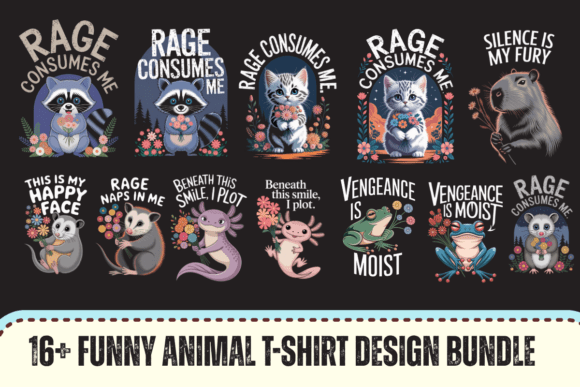
As someone who’s stitched over 300 custom apparel projects—from boutique baby onesies to Etsy sweatshirt collections—I opened the 16 Funny Animal T-Shirt Design Bundle expecting charm, not chaos. What I found was a tightly curated set of sarcastic, expressive animal faces paired with dry, relatable phrases like “Rage Consumes Me” and “Silence Is My Fury.” It’s not just clipart—it’s attitude with intention. And that matters deeply when you’re translating pixels into thread.
First Impressions: Personality That Stitches Well
The bundle lands with visual clarity: bold outlines, generous negative space, and balanced lettering that avoids cramped kerning or fragile serifs. These aren’t delicate watercolor animals—they’re confident, graphic, and built for impact. I immediately pictured one on a heavyweight cotton tote bag for a local coffee shop’s staff gift line: the “I’m Not Lazy, I’m in Energy-Saving Mode” sloth design, centered above the pocket, stitched in matte black thread on natural canvas. It reads instantly—even from six feet away—and feels handmade without looking amateurish.
That’s the real strength of the 16 Funny Animal T-Shirt Design Bundle: it bridges humor and craftsmanship. The animals aren’t overly cutesy or aggressively edgy; they land in that sweet spot where a 35-year-old teacher, a college student, and a small business owner all nod and say, “Yes, that’s me today.” That kind of resonance translates directly into stronger customer trust and repeat orders—especially for Etsy sellers and craft fair vendors building loyal followings.
Where It Shines (and Where It Needs Care)
In real embroidery use, this bundle excels on stable, medium-weight fabrics: cotton tees, twill aprons, brushed poly-blend sweatshirts, and linen tea towels. I tested the “My Therapist Says I’m Fine” raccoon on a crewneck sweatshirt using tear-away + cut-away stabilizer combo—and the satin stitch eyes held crisp detail, while the fill-stitch fur texture stayed breathable, not stiff. No puckering. No thread breaks.
But—and this is critical—not every design in the bundle behaves the same way. The “I Paused My Game to Be Here” owl has tighter text spacing than the others. On thin jersey or stretchy performance fabric, that phrase needs extra stabilization and possibly reduced stitch density to avoid shadowing or distortion. Likewise, the “Nope.” pug design works beautifully on flat surfaces like pillow covers or tote fronts—but on curved cap fronts? You’ll need to adjust placement and consider simplifying the mouth outline to prevent distortion during hooping.
For baby embroidery or nursery decor, lean into the softer sarcasm: the sleepy-eyed “I’m Not Ignoring You, I’m Recharging” koala reads as gently witty rather than cynical. It’s perfect for organic cotton burp cloths or muslin swaddle wraps—just confirm your thread colors contrast well against light pastels, and always pre-wash fabric to avoid shrinkage surprises.
Practical Notes Every Embroidery Designer Should Check
- Test before you commit: Run one design on scrap fabric matching your final project’s weight and stretch. Watch how corners hold, how dense fills settle, and whether tiny eyes or whiskers stay legible after stitching.
- Stabilizer isn’t optional—it’s foundational. Use medium-weight cut-away for knits, tear-away for stable wovens, and add a topping (like water-soluble film) for looped textures like terry cloth towels.
- Thread color contrast changes everything. A gray fox on heather charcoal looks sophisticated; the same design in pale yellow on cream reads as soft, not sarcastic. Always mock up in both light and dark backgrounds.
- Hoop size matters more than you think. Several designs in the 16 Funny Animal T-Shirt Design Bundle fit cleanly in a 4×4 hoop—but two push close to 5×7. Measure before digitizing or resizing.
- Licensing is non-negotiable. Since this is marketed as Graphics for T-shirts and apparel, confirm whether commercial use (e.g., selling embroidered patches or wholesale tote bags) is explicitly permitted. When in doubt, contact the seller—don’t assume.
- Small details need big attention. Tiny pupils, narrow speech bubbles, and fine whiskers can vanish if stitch density is too high or thread tension too loose. Zoom in on your embroidery software and verify stitch paths—not just the preview image.
More Than Just T-Shirt Designs—It’s Brand Language
This bundle does more than decorate fabric—it delivers tone. For a handmade shop launching a “Sarcastic Sunday” collection, these designs become consistent brand assets across product types: embroidered patches sewn onto denim jackets, heat-transfer vinyl versions on kids’ tees, even simplified line-art versions for printable greeting cards or digital stickers. That versatility makes the 16 Funny Animal T-Shirt Design Bundle unusually valuable for creative entrepreneurs juggling multiple income streams.
I recently used the “I’m 99% Sure This Is Fine” hedgehog on a limited-run batch of kitchen towels for a local maker market. Buyers didn’t just buy a towel—they bought a moment of shared relief. That emotional connection boosts perceived value, justifies premium pricing, and encourages social sharing. Which means better visibility for your Etsy shop, stronger repeat traffic to your small shop site, and more organic word-of-mouth than any algorithm could deliver.
Final Thought: Humor Has Texture—So Should Your Stitching
Great embroidery doesn’t shout—it invites. The 16 Funny Animal T-Shirt Design Bundle earns its place in your design library because it respects both the craft and the customer. It’s not trying to be everything; it’s confidently, clearly, and consistently *something*: witty, wearable, and well-built for real-world making. Whether you’re stitching personalized gifts for friends, building a holiday embroidery collection, or scaling a craft business, this bundle gives you reliable, expressive, and commercially viable design assets—not just pretty pictures.
Just remember: even the funniest animal needs thoughtful execution. So test. Stabilize. Contrast-check. And always ask yourself—not “Does this look good on screen?” but “Will this still make someone smile after 50 washes, three ironings, and one toddler meltdown?” That’s where true design judgment lives.