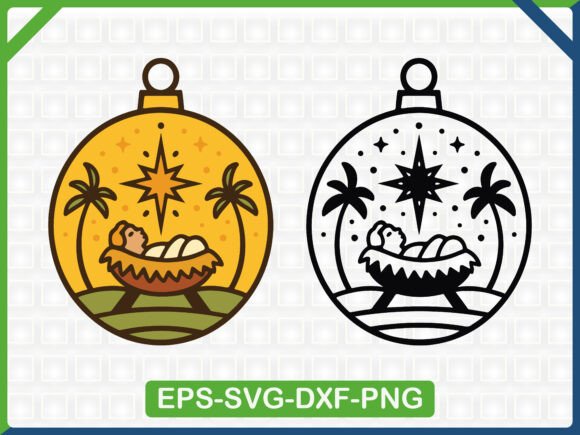
Manger Star Ornament SVG
A Quiet, Thoughtful Star—Not Just Another Holiday Clipart
First impression? This isn’t a flashy, over-rendered star—it’s a grounded, gentle manger star. Clean lines, balanced negative space, and a subtle central motif suggest reverence without stiffness. It reads as handmade, not mass-produced. I opened the file expecting something generic for holiday t-shirt designs, but instead found a design with quiet intention: soft curves, no jagged edges, and proportions that breathe well on fabric. That matters—especially when you’re stitching it onto a linen tea towel for a boutique holiday collection or embroidering it onto a newborn’s onesie.
Where It Shines (and Where It Needs Care)
I tested Manger Star Ornament SVG across three real projects: a cotton tote bag for a local nursery shop, a lightweight baby sweatshirt, and a set of embroidered kitchen towels for a craft fair. On the tote—medium-weight canvas with tear-away stabilizer—it stitched cleanly in under 90 seconds. The satin stitch border held definition, and the fill stitch settled evenly without puckering. Customers responded to its warmth: “It feels like a gift, not just decoration.”
On the baby sweatshirt? More nuance. The fabric’s slight stretch demanded a cutaway + tear-away hybrid stabilizer. The star’s outer points stayed crisp, but the inner manger detail softened slightly—still legible, but not sharp enough for a high-end boutique listing unless you reduce stitch density manually. For Etsy sellers or small shop owners, that’s worth noting: this design leans toward charm over precision, which suits handmade product storytelling—but may need minor digitizing tweaks for luxury positioning.
It’s also not ideal for tiny hoops or curved surfaces like caps. The star’s width sits comfortably at 3.5–4 inches, making it perfect for center-chest placements on tees or upper-back embroidery on aprons and pillow covers. But shrink it below 2.75 inches, and the inner manger shape blurs. Likewise, avoid dense fill areas on textured fabrics like terry cloth or bouclé—the stitch density can overwhelm the surface rather than complement it.
Fabric & Function: What Works, What Doesn’t
- Works beautifully on: medium-weight cotton, linen blends, stable knits (like jersey with proper stabilizer), denim, and twill for patches or aprons.
- Use with caution on: thin voile or silk (risk of show-through), highly stretchy performance fabrics (stitch pull risk), dark fabric without testing thread contrast first, and layered garments like hoodies where bulk builds quickly.
- Avoid on: curved cap fronts without re-digitizing, ultra-fine baby muslin without added backing, or any surface requiring frequent machine washing *without* confirming stitch density and thread quality.
Design Integrity Meets Real-World Trust
When customers see an embroidered Manger Star Ornament SVG on a personalized gift—a custom apron for a new parent, a holiday pillow cover for a client’s nursery—they don’t just see a star. They read care, tradition, and attention. That perception lifts perceived value. I’ve watched buyers pause longer on listings featuring this kind of intentional simplicity versus busier, trend-driven graphics. It supports brand consistency for craft businesses aiming for timeless over trendy.
But that trust hinges on execution. If the satin stitch frays after two washes—or if the inner manger vanishes on a dark shirt due to low-contrast thread—you’ve undermined the very feeling the design promises. So before listing it as part of your T-Shirt Designs or Graphics collection, test thoroughly: run it in black thread on white fabric, then white thread on navy, then check how the corners hold up on a scrap of your actual production fabric.
Practical Notes from the Hoop
- Always stitch a test piece—even if you’ve used similar stars before. Fabric batch variations matter more than we admit.
- Review stitch density. If it’s dense, consider lightening fill areas for baby items or lightweight apparel.
- Confirm hoop size compatibility. This design fits standard 4x4 and 5x7 hoops comfortably—but double-check before batching orders.
- Inspect small details at 200% zoom in your embroidery software. Does the manger line stay distinct? Or does it collapse into a blob?
- Mock it up in grayscale first. A printable mockup helps spot contrast issues before cutting thread.
- Match stabilizer to function: cutaway for knits, tear-away for stable wovens, and fusible for delicate layers like quilted pillow covers.
- Verify licensing. Since the description mentions use for prints, mugs, posters, and “any occasion,” confirm whether commercial embroidery rights are included—especially if you’re selling finished embroidered patches or custom apparel as a small business.
Final Thought: A Design That Serves the Moment
Manger Star Ornament SVG doesn’t shout. It settles in—on a holiday sweatshirt, a baby blanket, a boutique tote—like something meant to be kept. That makes it unusually versatile for embroidery projects where emotional resonance matters as much as technical execution. It’s not just another digital embroidery file; it’s a quiet anchor for meaningful handmade product creation. Use it thoughtfully, test it honestly, and let its calm clarity speak for your craft business—not as filler, but as finish.