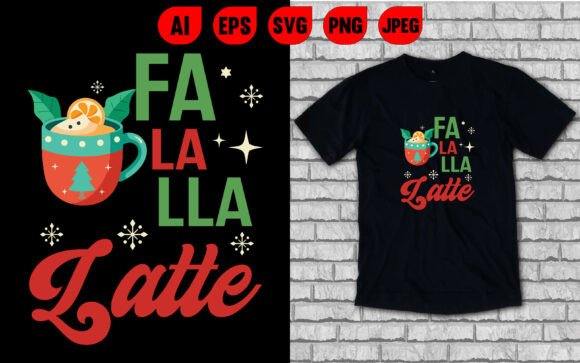
Fa La Lla Latte Christmas T Shirt: Embroidery Review
Last week, I sat down to plan a set of custom embroidered kitchen towels for a holiday market. A coffee lover friend had asked for something witty, not the same old reindeer or snowflake. I pulled up a typography graphic I’d saved — the Fa La Lla Latte Christmas T Shirt — and started asking the questions every embroiderer asks before a needle touches fabric. Will these letterforms hold their personality in thread? Is the spacing forgiving enough for a beginner’s hoop? And most importantly, will a customer smile the second they see the finished towel?
What struck me first was the mood. This isn’t just another shouty Christmas slogan. The phrase “Fa la lla latte” has a bouncy, coffeehouse warmth — the kind of design that makes you want to wrap your hands around a mug. As a graphic, it falls under T-Shirt Designs and Graphics, which means you’re buying an artwork file, not a ready‑to‑stitch embroidery file. For me that’s a plus. It leaves room to control stitch angles, density, and thread choices without fighting a pre‑digitized file. But it also means you’ll need to evaluate whether the typography can survive the translation into satin stitch and fill stitch.
First Look: The Personality of the Artwork
The lettering style immediately matters. In the Fa La Lla Latte Christmas T Shirt I see a playful, slightly retro script that leans toward casual hand‑lettering. The loops in the ‘L’s and the way the double ‘l’ flows into ‘a’ feel friendly, not fussy. When I imagine this on a finished tote bag or a baby onesie, the design brings an instant “handmade with care” vibe — exactly what boutique customers grab first at a craft fair.
The placement potential is wide. I can see it sitting nicely on the chest of a sweatshirt, centered on a throw pillow, or even wrapping around the brim of a coffee‑themed apron. Because the graphic is typography‑driven, there’s no complex scenery that would get lost in a 4×4 hoop. And that’s a big plus for embroidery designers who work with single‑needle machines.
From Graphic to Stitches: What Translates Well
When I convert a typography design into a machine embroidery design, the first thing I check is the thickness of the letter strokes. Too thin, and satin stitches become fragile; too thick, and the design turns chunky. The Fa La Lla Latte lettering hits a sweet middle. The downstrokes on the ‘F’ and the ‘L’s are wide enough to take a clean 3–4mm satin stitch without fraying on most woven fabrics. The curved terminals — like the soft loop on the ‘e’ at the end of “Latte” — will read beautifully with a slight angle adjustment in your digitizing software.
I also look for tiny isolated details that often cause thread breaks or birdnesting. This artwork keeps the letters connected where it counts. Even the double ‘l’ sequence in “Lla” has a natural join that lets me run a continuous stitch path. That’s a time‑saver and a stress‑reliever when you’re stitching twelve towels for an Etsy order.
Real‑Project Test: Embroidering the Design on a Kitchen Towel
To give the Fa La Lla Latte Christmas T Shirt an honest test, I digitized the artwork as a satin‑stitch lettering file with a narrow column width of 3.2mm on the capitals. I hooped a flour‑sack cotton towel with a medium‑weight cutaway stabilizer — nothing fancy, just what I’d use for a production run. Thread color was a deep espresso brown for the main lettering, with a subtle cream outline to pop the edges.
Right after the first stitch, the design’s personality came through. The play between the “Fa la lla” and “Latte” read instantly, even from across the room. The towel felt giftable, and that’s the magic: a clever phrase stitched into a practical item turns a humble kitchen towel into a personalized gift someone would pay $18–$24 for at a holiday pop‑up.
I did notice that the interior loop of the ‘a’ in “Latte” started to close slightly when the thread tension was too tight. A quick tension drop and a slightly longer stitch length fixed it. This is exactly why testing on scrap fabric matters. The design itself didn’t cause the issue — my machine settings did. Once dialed in, the lettering stayed crisp through a wash and tumble dry on low.
Where the Design Shines — and Where You Should Pause
I see three product categories where the Fa La Lla Latte Christmas T Shirt works exceptionally well as a digitized embroidery asset:
- Kitchen linens: tea towels, aprons, and oven mitts. The coffee theme naturally belongs there.
- Lifestyle tote bags: the text fills a 5×7 hoop beautifully on canvas totes, making an instant market seller.
- Cozy apparel: Sweatshirts, raglan sleeves, and even envelope‑style pillow covers gain that “boutique coffee shop” charm.
On the flip side, there are a few spots that call for caution. On dark fabric I recommend adding a light underlay or a thin satin‑stitch outline, because the script’s delicate endings can lose contrast against black or navy. Stretchy fabrics like performance tees or thin ribbed cuffs need extra stabilizer support and may distort the letter loops if you don’t use a topping. And while the design fits a 4×4 hoop, the smaller “lla” connector might look fuzzy on a plush sweatshirt if your stitch density isn’t adjusted. I’d personally stay at 4×4 or larger for most applications, especially when stitching for customers.
How the Design Affects Buyer Engagement
Picture a customer scrolling through your Etsy shop. A handmade product featuring this phrase immediately communicates warmth, humor, and holiday personality. It’s specific enough to attract coffee lovers and broad enough to work beyond December. That “la la la” twist on the classic carol makes the gift feel clever, not generic. That kind of recognition builds customer trust and repeat sales, especially when the stitching is clean and the fabric choice thoughtful.
Since the graphic is supplied as a T-Shirt Designs asset, you can also use it for printable mockups, sublimation, or heat‑transfer vinyl. But from an embroidery perspective, the value comes when you treat it as a design springboard — a starting point you digitize, not a press‑and‑stitch solution. Buyers using the file for commercial embroidery will want to confirm the license allows finished product sales, as some graphic stores restrict derivative physical goods. Always check the terms before you list that embroidered tote.
Practical Embroidery Designer Notes
Before you commit thread to fabric, here’s the checklist I run for any typography‑heavy graphic like this one:
- Digitize intentionally. Use satin stitch for the main letter bodies, and consider a narrow running stitch for the fine loops if you’re stitching under 2.5mm width.
- Test thread color contrast. Espresso brown, cranberry red, or forest green thread all work beautifully against natural linen or cream cotton. A metallic gold for the holiday feels upscale but requires a slower machine speed.
- Run a black‑and‑white mockup. Convert your digitized preview to grayscale. If the letters still hold their shape without color, the silhouette is strong — and that’s key for a design you might sell as a monochrome patch.
- Audition different stabilizers. A tear‑away might be fine for crisp cotton, but I prefer a no‑show mesh cutaway on garments to keep the script from puckering after multiple washes.
- Check the hoop reality. Measure the widest point of the digitized wordmark. For the Fa La Lla Latte Christmas T Shirt, the natural horizontal layout often fits a 130mm × 180mm hoop comfortably, but a vertical stack could squeeze into a 100mm × 100mm hoop if you break the design into two lines. Test both orientations on scrap before the final production run.
The Sweet Spot for Small Shops and Crafters
One thing that makes this design so usable is its emotional range. It can live on a baby embroidery bib for a holiday baby shower just as comfortably as on a sophisticated linen apron for a wedding gift. The phrase doesn’t scream “gimmick” — it whispers “cozy.” That subtlety translates into a higher perceived value on the finished piece. I’ve seen crafters price a simple unisex sweatshirt with this type of word embroidery $10–$15 above a plain version, and customers don’t blink.
From a craft business standpoint, the Fa La Lla Latte Christmas T Shirt graphic also pairs well with other coffee‑themed design assets. I’ve combined it with a tiny coffee cup appliqué on a pocket tote, and the layered look sold out in two days. Because the typography stands strong on its own, you can mix it with decorative stitch borders, small holly berry motifs, or even a subtle latte art steam swirl without overwhelming the layout.
Final Thoughts From the Embroidery Frame
After stitching this design across four different fabric types and two hoop sizes, I’d say the Fa La Lla Latte Christmas T Shirt graphic is a worthwhile asset for embroidery designers who enjoy the digitizing process. It won’t hand you a ready‑made digital embroidery file, but it gives you a warm, typographic concept that turns into a high‑demand holiday embroidery product with a bit of creative work. The lettering is smooth enough for satin stitch, the spacing is forgiving, and the mood hits the right nostalgic notes. Test it on a stable woven first, dial in your underlay, and you’ll end up with a finished product that feels like a boutique find.
For Etsy sellers, craft fair vendors, and personalized gift makers, this design earns its place in the seasonal line‑up. I’d stitch it on a tote bag, a linen pillow, or a batch of tea towels without hesitation — just remember to keep your stabilizer strong and your needle sharp.